09 Special vehicles and signals
Every road user must give way to a vehicle running a blue (or red) flashing beacon with its siren on — even if that means departing from a sign or marking — as soon as it can be done safely.
1
When approaching a stationary vehicle with a red flashing light on, the drivers of public vehicles traveling in that direction should:
- A Stop and continue the traffic only after getting permission.
- B Reduce speed so that they can stop immediately if necessary.
- C Continue the traffic, as they are traveling on the defined route.
2
Audio signals may be used by drivers of public vehicles:
- A To gain an advantage over other road users.
- B In the settlements to warn other drivers about the intention to overtake.
- C When it is necessary to prevent a traffic accident.
- D In all the cases above.
3
Is it necessary for the dipped headlights to be switched on during the daylight hours with a special lane on public transport vehicles facing the main flow?
- A Mandatory
- B Not mandatory
4
When approaching a vehicle with a flashing blue light and a special audible signal, drivers of public vehicles should:
- A They will continue the traffic, as they are traveling on the defined route.
- B Give way to ensure the unimpeded passage of the mentioned vehicle.
- C Reduce the speed and give way to ensure the smooth passage of the mentioned vehicle.
5
In the dark hour of the day, the bus moving in the unlit parts of the road along the defined route should use
- A Only the low beam.
- B Only high beam.
- C low and high beams
6
In what case do the rules not require a warning signal to be given?
- A Before stopping at the edge of the roadway.
- B Before a curve of the road marked with a "Dangerous Turn" sign.
- C Before convertingto an adjacent traffic lane.
7
When should the warning signal be given before changing lanes?
- A Immediately before starting the maneuver.
- B Immediately after the start of the maneuver.
- C In good time before the start of the maneuver.
8
The driver's hand warning signal is stopped:
- A Immediately before starting the maneuver.
- B Immediately after completion of the maneuver.
- C During the execution of the maneuver.
9
What general alarm signals must the driver sound when a vehicle is forced to stop at a railroad crossing?
- A Three long and one short.
- B One long and three short.
- C One long and two short.
10
A warning signal must be given before the maneuver:
- A Immediately before starting the maneuver.
- B Simultaneously with the beginning of the maneuver.
- C In advance, before the start of the maneuver.
11
When is a driver required to give a warning signal before stopping?
- A Only if another vehicle is moving behind it.
- B Only in populated areas.
- C In all cases.
12
In the absence or malfunction of a turn signal light, the warning signal by hand is discontinued:
- A Immediately before performing a maneuver.
- B Immediately after completion of the maneuver.
- C During execution of the maneuver.
13
The signal of a general alarm at a railway crossing is a series of:
- A Two long and two short signals.
- B One long and three short signals.
- C Three long and three short signals.
- D Three long and one short signal.
14
When approaching a parked vehicle with a red flashing beacon on, drivers of vehicles moving in that direction must:
- A Stop and continue driving only after getting permission to do so.
- B Reduce the speed to be able to stop immediately if necessary.
15
When approaching a vehicle with a blue flashing beacon and a special sound signal, drivers are obliged:
- A Give way to ensure the unobstructed passage of the said vehicle.
- B Reduce speed and give way to ensure unobstructed passage of the specified vehicle.
16
Which picture shows the driver signaling a left turn warning:
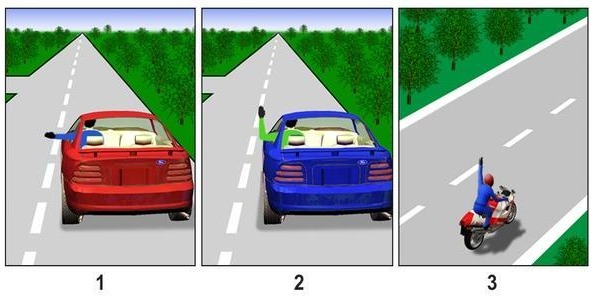
- A 1
- B 2
- C 3
17
What are flashing beacons of orange or yellow color mounted on vehicles for?
- A To gain an advantage over other road users.
- B To warn other road users of the danger.
18
The blue car will drive through the intersection:
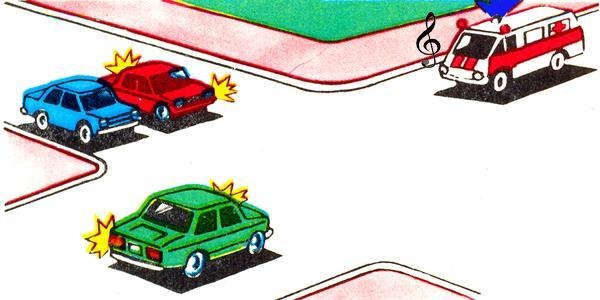
- A The first at the same time as the red.
- B Second simultaneously with red.
- C The third simultaneously with red.
19
When approaching a vehicle with flashing beacons of blue and red color and a special sound signal, drivers are obliged:
- A Give way to ensure the unobstructed passage of the said vehicle.
- B Reduce the speed and give way to the road, to ensure the unobstructed passage of the specified vehicle, as wellas vehicles accompanied by it.
20
The black car will drive through the intersection:
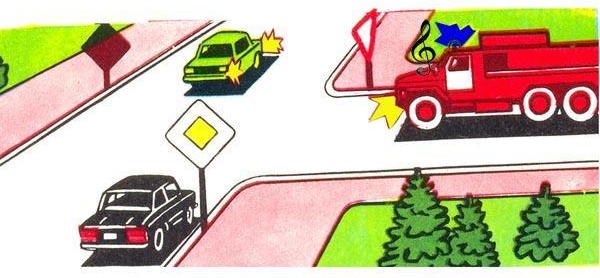
- A The first.
- B The second.
- C The third.